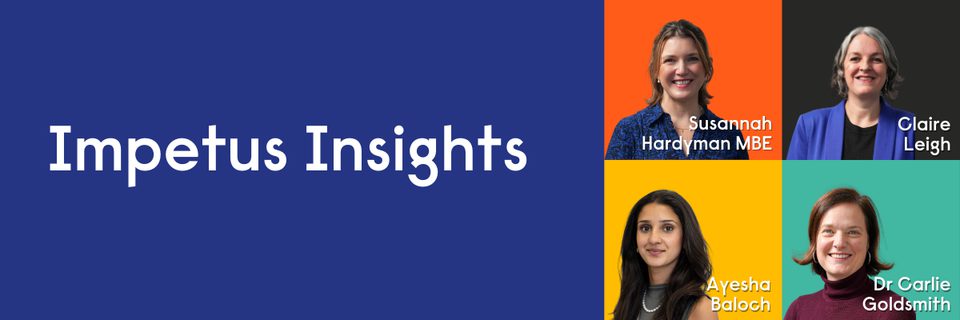
Welcome to Impetus Insights... a place where we discuss ideas, articles and interesting reading about education and employment policy - and what we think it means for young people from disadvantaged backgrounds. We share this every month alongside news and updates about our own policy work. We’d love to hear what you think of this edition, and what you’d like to see in future newsletters.
Sign up to get Impetus Insights direct to your inbox every month here.
In the unlikely case that you missed the news, on 17 November Alan Milburn published the final report of his review into Young People and Work. It was a real privilege to be in the room for the launch and to hear directly from Alan and his youth ambassadors. One line from Olivia, one of those ambassadors, has stayed with me: "Young people have not failed. Young people have been failed."
The report is hugely ambitious, setting out a ten-year path with a compelling vision. We were very pleased to see eight of the fourteen recommendations from our Closing the Youth Jobs Gap report reflected in full, and the remaining six in part. It also recognises the link between experience of poverty and NEET outcomes. But we know this link can be broken; we see it in our work with partners all the time. When young people get the right support at the right moments, and when they have someone in their corner, they can fly. Below, Ayesha and Carlie set out where we think the report gets it right on youth employment and education, and where it needs to go further, particularly for young people with experience of poverty beyond 16.
Much of the evidence behind our response comes from our Youth Jobs Gap research. Last month we marked nine years of that work with colleagues past and present, partners from across the sector and Lord Blunkett. Eleven reports and an interactive tool later, the NEET crisis is firmly on the public agenda, and we're proud of the part this research has played in getting it there. Thank you to everyone who has contributed along the way.
The question now, and it’s a very big question, is the all-important implementation. As Alan said at the launch, half measures will not do. With a White Paper due next year, we'll be working with our portfolio partners and colleagues across the sector to make sure this ambition is matched by funding, delivery and better outcomes for the young people who need it most.
Enjoy reading,
Susannah

In this issue
In this edition, we share our reaction to Alan Milburn's final report on Young People and Work, which fully reflects eight of the fourteen recommendations from our Closing the Youth Jobs Gap report. We also look at what its ambitious education reforms could mean for young people with experience of poverty. We mark nine years of our Youth Jobs Gap research - celebrated last month with Lord Blunkett - and reflect on what it has taught us about who is NEET and why.
As devolution plans heat up, we consider the impact this could have on local employment support schemes, as well as anticipated changes to the education system, and the Children's Commissioner's report on education in Young Offender Institutions. And finally, we explore how AI could reshape the first rung of the career ladder, and what young people need to thrive in an AI-enabled world without widening existing inequalities.
News and views
Our focus here, as at Impetus, is on the outcomes that we know work to improve the life chances of young people from disadvantaged backgrounds – school engagement, educational attainment, and sustained employment.
- After months of anticipation, the final report of Alan Milburn’s review into Young People and Work landed on 17 November. I was up bright and early at 5am to speak to Times Radio about what we make of it, and the short answer is that it gets the level of ambition and a lot of the architecture right. Of the fourteen recommendations in our Closing the Youth Jobs Gap report, eight were fully reflected and six partially. These range from a statutory 'Opportunity Guarantee' - something we have long called for as part of the Youth Employment Group and in our latest report - and a single, locally-led front door for every young person regardless of benefit status, to a shared data infrastructure which tracks young people up until the age of 24. Alan Milburn begins by agreeing that "poverty and inequality are at the core of the NEET crisis" (while citing our work!) and rightly calls for supporting those young people facing the highest barriers. The chapter on education echoes many of our own calls, though there are warnings that an already over-stretched school system will not be able to achieve this without proper investment. However, the emphasis on the link between poverty and outcomes in school and later life diminishes beyond the school system: those from poorer backgrounds are largely omitted from the groups of young people in need of extra support after age 16. The financial barriers that put apprenticeships out of reach for low-income families remain largely untouched and Area Youth Participation Plans do not include young people with experience of poverty as a priority group. This is surprising, considering everything we know about the long-term effects of growing up with experience of poverty, which last far beyond the classroom. The government's initial response is welcome, and we're pleased to see the new Youth Opportunities Unit, reporting to the Prime Minister - which echoes our call for cross-government ownership - alongside an extension to the Jobs Guarantee eligibility criteria to young people out of work for 12 months. This brings a further 90,000 young people furthest from work into scope, also something Impetus has long called for. Ultimately, while we are thrilled to see young people neither earning nor learning finally get the spotlight they deserve, the real test will be implementation. Can a system led largely by mayors and strategic authorities avoid becoming a postcode lottery when those authorities are yet to be created in many areas and have vastly different capacities where they do exist? Will the ambition be backed by the necessary funding? And can the system and political philosophy laid out in this report survive the current economic climate and a looming general election? Only time (and outcomes) will tell. (Ayesha Baloch, Head of Youth Employment Policy)
- The Milburn Review final report went big on education, setting out a bold new vision and purpose for the system. The key shifts, put simply, are from reacting to detachment to preventing it, from measuring qualifications to ensuring successful participation, and from separate institutions to “a continuous pathway from childhood to working life.” Impetus exists to transform the education and employment outcomes of young people with experience of poverty and so we welcome the report’s real focus on disadvantage in education. Things I liked: expanded Best Start Family Hubs and a push on literacy to boost the number of pupils reaching the expected standard at Key Stage 2. Things we’ve championed that were included: a bigger focus on reengaging students with school that included a multi-agency response to persistent absence - vital because schools can’t tackle this alone - and a named adult for every student at risk of disengagement. One thing we welcome that could have gone further: some movement on additional funding at 16-19, but that fell short of the introduction of a full 16-19 Student Premium. We were also reassured that the report echoed our warning that technical GCSEs could create a two-tier system, further disadvantaging young people with experience of poverty. We don’t believe that’s the government’s intention. However, everything that happens next in this space must be tested against one question: does it open doors for young people with experience of poverty, or close them? The devil is always in the detail and if government commits, then delivering this agenda will take sustained political attention and extra investment. Some of the report’s key recommendations have already prompted concerns about pressure on a stretched school system. Others question the path set by Milburn to make school the route to work, and question whether the reasons England’s schools are doing so well in the international PISA rankings were considered. We know that for young people with experience of poverty, making schools places they want to be alongside strong teaching, availability of early support and high-quality qualifications, especially GCSE English and maths, are essential for the journey into employment. The government will set out its full response in a White Paper next year. (Carlie Goldsmith, Head of Education Policy)
- Last month we celebrated nine years since starting our Youth Jobs Gap research with partners old and new, and we were honoured to be joined by Lord Blunkett. The evening marked the close of the programme, which included eleven reports and our interactive tool, all to build a clearer understanding of who is not in education, employment or training (NEET), where they live and what barriers they face. Our first report in 2019 put a number on a gap we had always believed existed: young people from disadvantaged backgrounds are twice as likely to be NEET as their better-off peers. Since then, we've learned that qualifications matter, but their benefits aren’t shared evenly, with young people with experience of poverty still 50% more likely to be NEET than similarly qualified peers. Crucially, those facing "triple jeopardy" characteristics (disadvantaged backgrounds, low qualifications and SEND) are almost three times more likely to be NEET than average. Thank you to everyone who has been part of this work. With the Milburn Review now complete and the work of implementation beginning, the evidence on who is NEET, and where, has never felt more important. (Ayesha Baloch, Head of Youth Employment Policy)
Top reads
Here’s our roundup of some of the most useful and thought-provoking reads across a range of interesting areas...
- Devolution continues to be a recurring theme. The Autumn Budget committed £100m over two years to expand the Mayoral Apprenticeship Brokerage pilots from seven to fourteen strategic authorities. We cautiously welcome more power and resource for places to join up support for young people, but recent research shows how much rests on the detail. Centre for Cities calculates that across England's seven established mayoral areas, mayors control only 15% of that employment support spend. It warns that they risk being set up to fail unless devolution comes with enough funding and incentives. Back in 2020, New Local's No Strings Attached raises a complementary question about where power ends up, calling for community-led devolution of 16-19 education, careers advice and support for people with complex needs, so that power isn't simply held by local authorities, but is actually shared across the local skills system. As our research shows, rates of young people not in education, employment or training (NEET) differ widely between local areas, and City-REDI finds they are closely linked to the strength of local labour markets. Those are exactly the gaps devolution must not widen. With Milburn placing significant responsibility on mayors and local partners, the question now is whether they will have the funding and flexibility to match, and whether the places with the weakest labour markets get the most support, rather than the least. (Ayesha Baloch, Head of Youth Employment Policy)
- As Milburn’s review talks about ‘broadening’ educational success across subjects, I’ve been wondering what role the humanities and languages will play. I read Daisy Christodoulou’s Why are we making these mistakes again? Substack with interest - especially her considerations of the impact of the removal of the EBacc, announced in November 2025. How, without it, England could see its smallest-ever cohort of language GCSE students by 2028, while History and Geography may be squeezed as new vocational qualifications compete for timetable space. With the Education Secretary’s plans to put oracy on a par with reading and writing, this sits uneasily with me. I’d argue that languages and the humanities are where pupils most often learn to debate and build an argument. Weakening them while championing oracy feels like a contradiction. And remember - the impact won’t fall evenly. A Teacher Tapp survey for Schools Week earlier this year found that schools with the highest free school meal eligibility were three times as likely to cut the number of languages offered at GCSE, while private schools were far less likely to cut. At Impetus, we believe every young person deserves the same opportunities, and pupils from poorer backgrounds shouldn’t lose academic options their better-off peers keep. (Emily Corcoran, Policy Officer)
- “If we can’t be ambitious about the most vulnerable children in our society, then what does that say about us?” is one contribution in a deeply moving and detailed report by the Children’s Commissioner on the state of education in England’s Young Offender Institutions. Prison is a closed institution where it is too easy to ignore the hundreds of children - most of whom were eligible for free school meals (FSM) prior to their imprisonment - who rely on the education provided there as the foundation of a better life. Essential reading. (Carlie Goldsmith, Head of Education Policy)
Look ahead
- 26 November: Quarterly stats release on the number of young people not in education, employment or training (NEET)
- 10 December: KS2 attainment revised statistics are released
- 15 December: ONS's regional labour market statistics, giving us a better picture of youth unemployment
- 17 December (potentially): Burnham's 10 Year Plan - which he promises will show his “clear vision for Britain”
And finally...
AI isn't coming for young people's jobs so much as for the first rung of the ladder. That's the striking takeaway from Josh Hillman's new blog for the Ada Lovelace Institute. Junior members of staff have traditionally started their careers doing routine tasks like drafting, summarising and crunching data, and those are exactly what AI does best. That could leave entry-level roles narrower and fewer in number. The evidence that AI is actually causing entry-level roles to disappear is still thin, but the direction of travel should worry anyone who cares about young people from disadvantaged backgrounds. Hillman's answer isn't "more technology" or "less technology". It's supporting young people to acquire solid foundational knowledge, durable essential skills and real AI literacy, which he sums up as "knowing how to question it". He also makes the case for careers guidance that pairs AI-powered information with trusted humans. And in terms of how AI is deployed in the classroom, one line stood out for me: "Effort is not an inefficiency in education." And AI in schools could open up further gaps in learning, with better-off pupils using AI as a scaffold while disadvantaged pupils get it as a cheap substitute for human support. With the Nuffield Foundation finding that 45% of families with children fall short of the Minimum Digital Living Standard, the digital gap is real. Preparing young people for the AI era means preparing all of them, not just the ones already ahead. (Claire Leigh, Director of Public Affairs)