
981,000 young people in the UK are now not in education, employment, or training (NEET) according to the latest ONS figures.
New analysis from youth employment charity Impetus reveals the scale of the NEET crisis is also a huge long-term financial burden on the state, with each young person who becomes NEET costing an average of £244,000 over their lifetime.
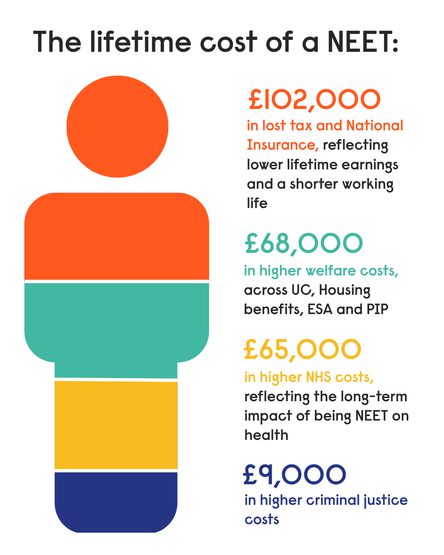
This includes, on average, £102,000 in lost tax and National Insurance revenues, £68,000 in higher welfare and benefit costs, £65,000 in higher NHS costs due to long-term health impacts, and £9,000 in higher criminal justice costs.
With almost one million young people currently NEET, the current lifetime cost to the public purse runs into roughly £240 billion. Beyond the economic cost, high NEET levels have a long-term scarring impact on young people, with some groups disproportionately impacted:
- Spending time unemployed under the age of 23 has been linked to lower wages even two decades later.
- Those who are NEET at 18–19 are 20% more likely to be unemployed 10 years on.
- Young people from disadvantaged backgrounds are twice as likely to be NEET than their better-off peers, with qualifications only accounting for half the difference.
Certain factors amplify this risk. Previous Impetus research found that a young person from a disadvantaged background with low qualifications and special educational needs and disabilities is nearly three times more likely to be NEET than their better-off peers.
However, having strong educational qualifications makes young people less likely to become NEET, with their risk roughly halving each time they gain a higher-level qualification. For those who face the biggest barriers to finding work, practical support such as mentoring and career coaching is also essential.
Impetus’ new Youth Jobs Gap report sets out clear, actionable recommendations for the UK Government to break this cycle and support the more than one million young people currently left out of education and work.
Susannah Hardyman MBE, CEO of Impetus, said:
"As the numbers of young people neither earning nor learning remain high, the costs to the public purse also remain high unless the Government acts. The consequences are not just devastating for young people themselves – they carry a huge and growing cost for the taxpayer.
We estimate that each young person who becomes NEET costs the state an average of £244,000 over their lifetime, through lost tax revenues and higher welfare, NHS and criminal justice costs. With more than one million young people currently NEET, the scale of this financial challenge is staggering.
For those young people furthest from the world of work, particularly those facing socioeconomic disadvantage, low qualifications and special educational needs and disabilities, the right support needs to be offered as early as possible, starting in school. These young people are more likely to become NEET – but this can change.
Investing in young people is both the right thing to do an economic imperative, giving young people the support they need to stay in education and move into work can prevent a lifetime of lost opportunity, while reducing the billions of pounds in future costs to the state."
Susannah Hardyman MBE, CEO, Impetus
For general media enquiries, please contact Nicola Robbins and Emily Dalton at press@impetus.org.uk or call 07774 437 701.
About the data:
£240 bn calculated using Impetus's Lifetime Cost of a NEET Young Person model (June 2026) applied to the ONS's latest NEET estimate for 16–24-year-olds (Apr–Jun 2026, Labour Force Survey)
Impetus’s ’Lifetime Cost of a NEET Young Person’ calculation is made up of average estimates of:
- £102,000 in lost tax and National Insurance, reflecting lower lifetime earnings and a shorter working life
- £68,000 in higher welfare costs, across Universal Credit, Housing Benefit, ESA and PIP
- £65,000 in higher NHS costs, reflecting the long-term scarring impact of being NEET on physical and mental health
- £9,000 in higher criminal justice costs
This is a deliberately conservative estimate, sitting below the University of York's long-standing benchmark of roughly £256,000 once uprated for inflation.
About the Youth Jobs Gap series
Impetus’ Youth Jobs Gap series is a groundbreaking collection of reports investigating the link between education and employment outcomes. The latest Youth Jobs Gap report, published in July 2026, looks wat ways we can close the gap and includes 14 recommendations specifically tailored to reach young people from disadvantaged backgrounds, who are twice as likely to not be in employment, education, or training (NEET).
Working with The National Institute of Economic and Social Research (NIESR), Impetus analysed the government’s Longitudinal Educational Outcomes dataset to explore how combinations of characteristics impact NEET rates compared to the average. For the first time it shows the links between socioeconomic background, level of qualification, identity characteristics and employment outcomes, giving us the clearest picture to date of the factors associated with employment outcomes for different groups of young people.
